

Dalmaji
달맞이
Korean for travel — and the reading that goes with it
Land in Korea already able to read the signs
340 travel phrases with Hangul, romanization and clear audio; enough Hangul in about 30 minutes to read signs and menus rather than memorise a chart; a 60-dish Menu Decoder; a won converter; and 72 Korea travel tips. Offline, on iPhone and Android, in 12 languages.

Made by Quantum Quacks · sister app to Kotomaji and Handarin
What is Dalmaji?
Dalmaji (달맞이 — Korean for going out to see the moon) is a Korean travel phrasebook and Hangul reading app for iPhone and Android, developed by Quantum Quacks. It contains 340 travel phrases in 13 categories — each with Hangul, the official Revised Romanization, a phonetic easy reading written for Spanish speakers and clear Korean audio, with politeness notes where they matter — Hangul in 30 minutes (the 40-letter alphabet, a 6-lesson crash course and a “Read the street” exam) so you can read Korean signs and menus yourself, a Menu Decoder with 60 dishes, 90 Konglish words you already know, a won converter across 23 currencies, and a 72-tip Korea travel guide. Everything is bundled in the app and works offline; the network is only used to refresh exchange rates, handle purchases (through RevenueCat) and, on iPhone, keep an iCloud copy of your progress. Dalmaji has no account, no ads and no tracking. It is the third app in the same family as Kotomaji (for Japan) and Handarin (for China). Released in September 2026, it is available on the App Store for iPhone (iOS 17 or later) and on Google Play for Android (7.0 or later) — free to download with an optional one-time Pro unlock.
- Category
- Education
- Platform
- iPhone · iOS 17+
Android 7.0+ - Price
- Free · Pro one-time
- Developer
- Quantum Quacks
Main Features
Four tabs: Phrases, Learn, Won and Guide
340 Travel Phrases
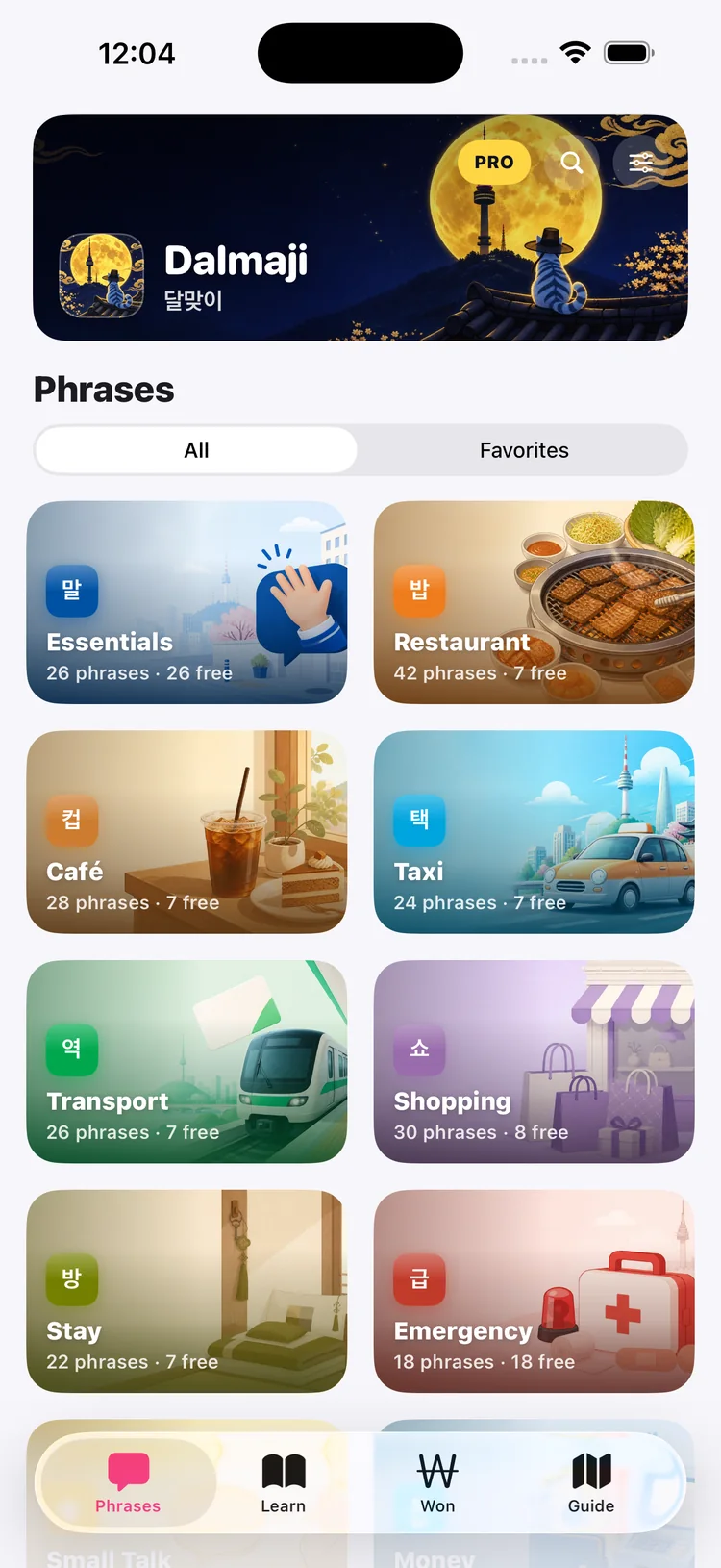
Thirteen categories built around the real moments of a trip to Korea, from ordering at a barbecue table to asking a pharmacist for help. Every phrase in polite -요 / -니다 forms — never casual speech.
Hangul in 30 Minutes
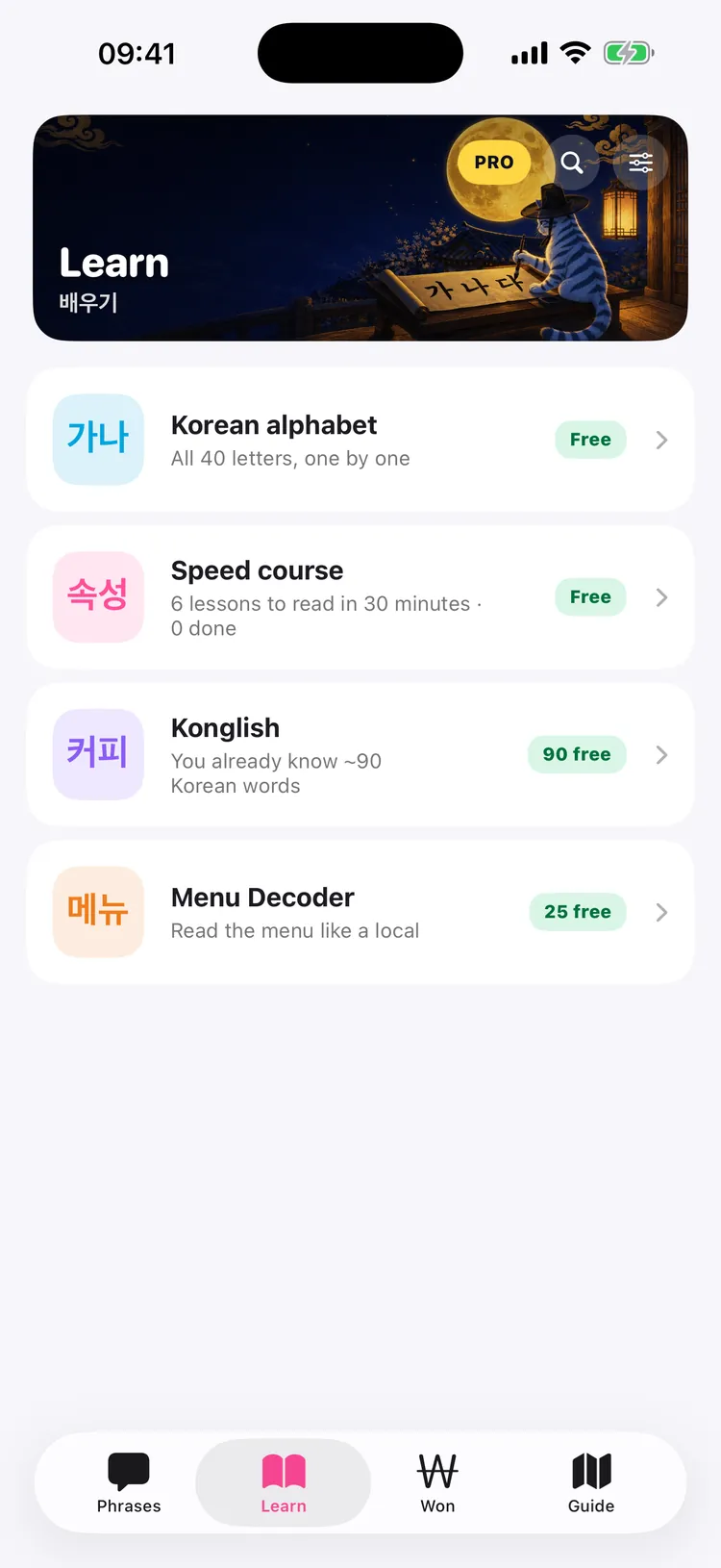
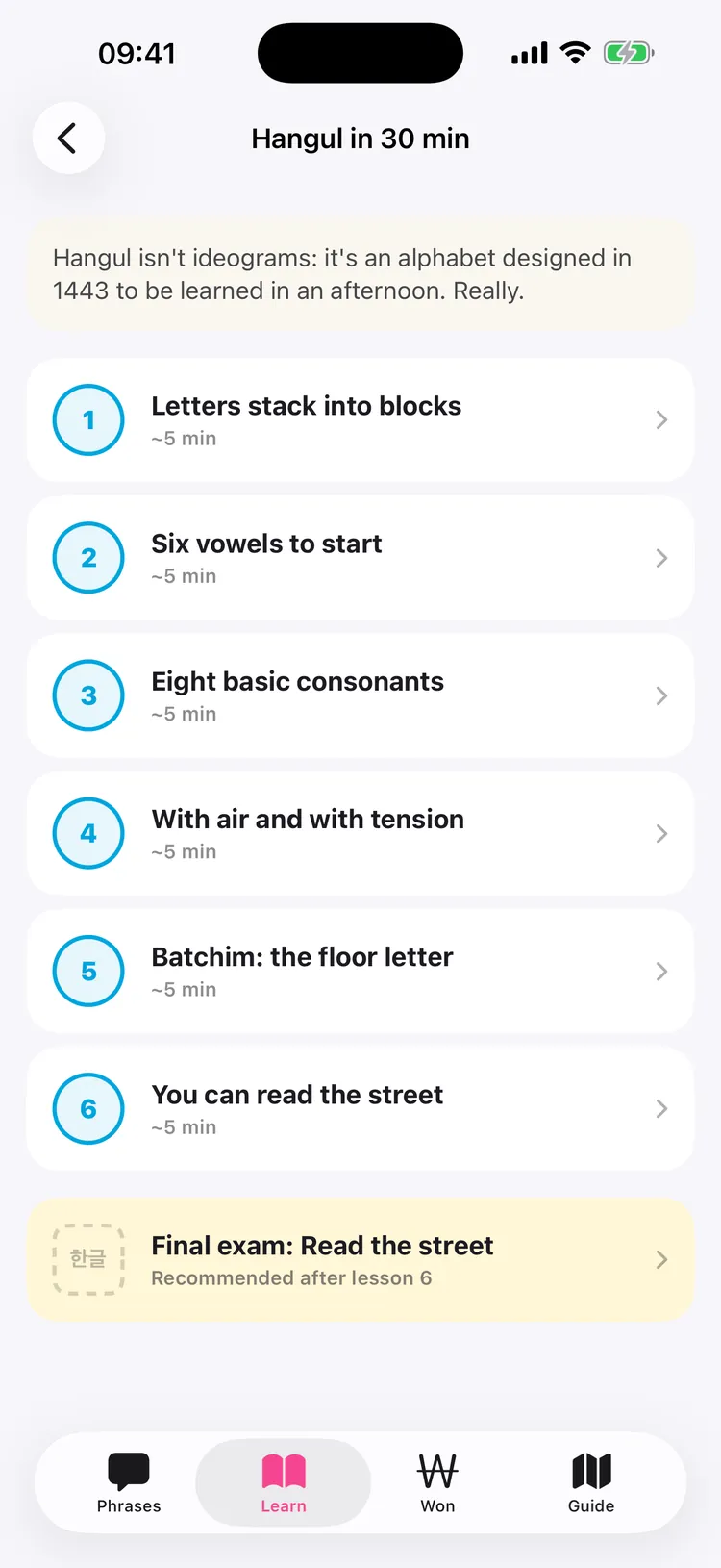
Enough Korean reading to get through a street: the full 40-letter alphabet with audio and the syllable table, a 6-lesson crash course, and a “Read the street” exam built from 12 real signs.
Menu Decoder
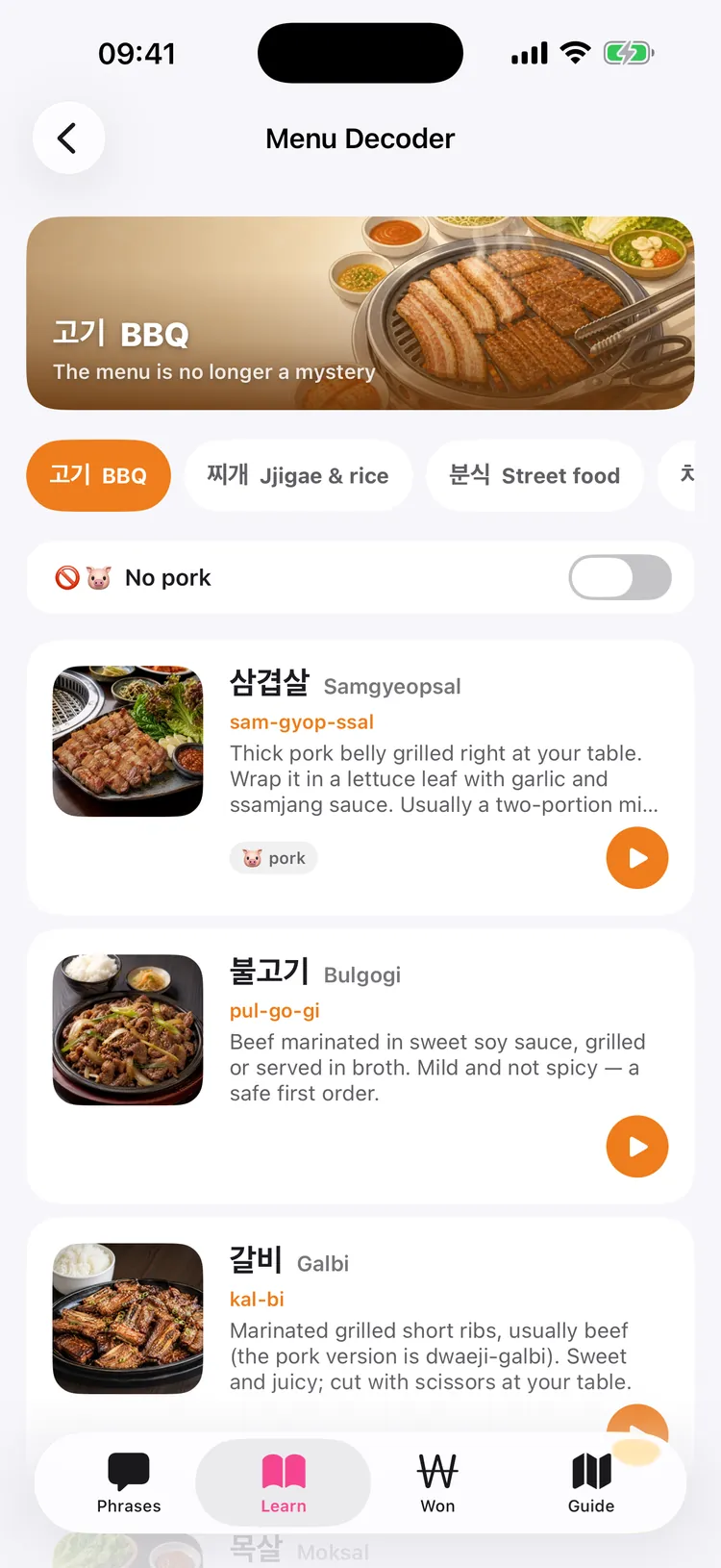
Sixty Korean dishes with a plain description, a spice level and pork, seafood and veggie flags — grouped by the place you are standing in: barbecue, jjigae, street food, chimaek and café.
Won Converter
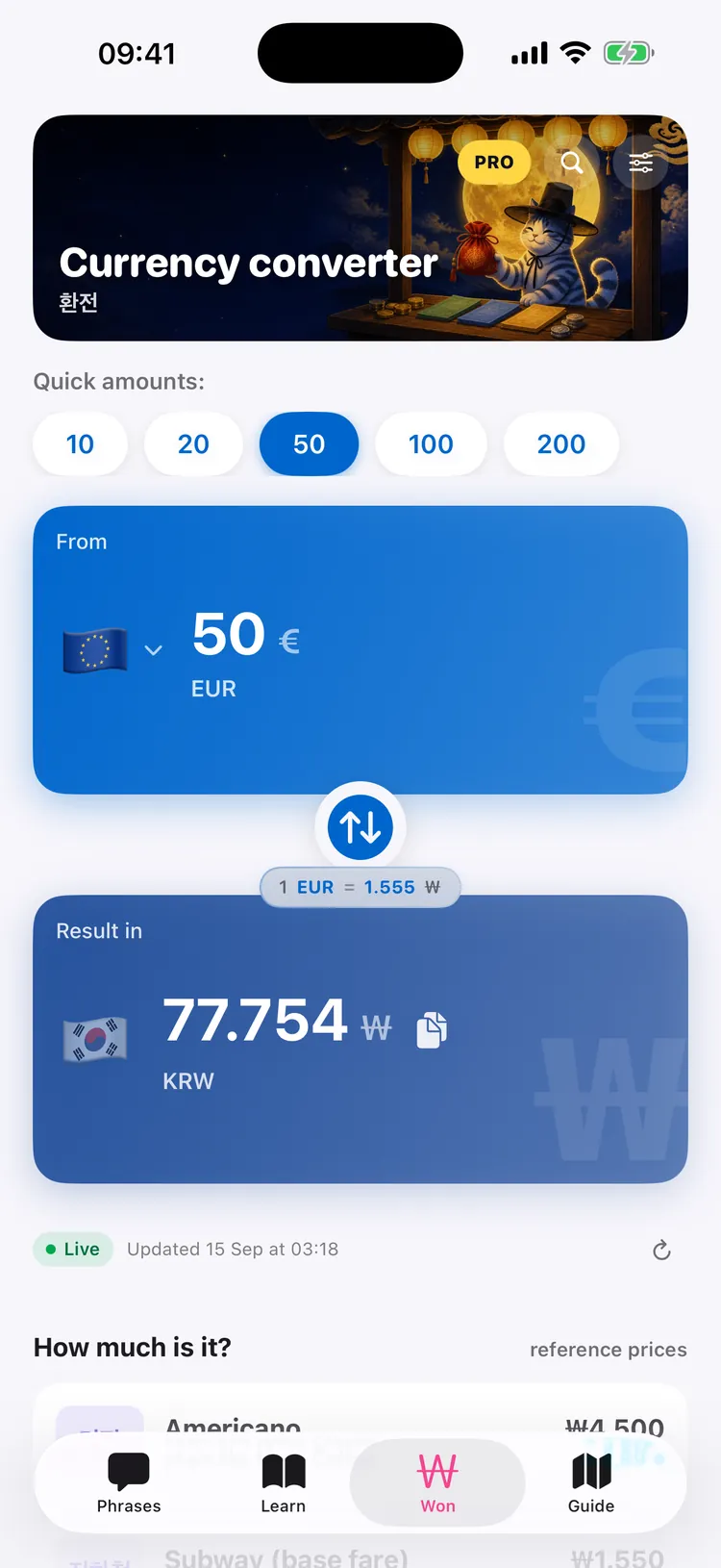
Twenty-three currencies with rates refreshed whenever you have a connection and kept for offline use, and one-tap quick amounts.
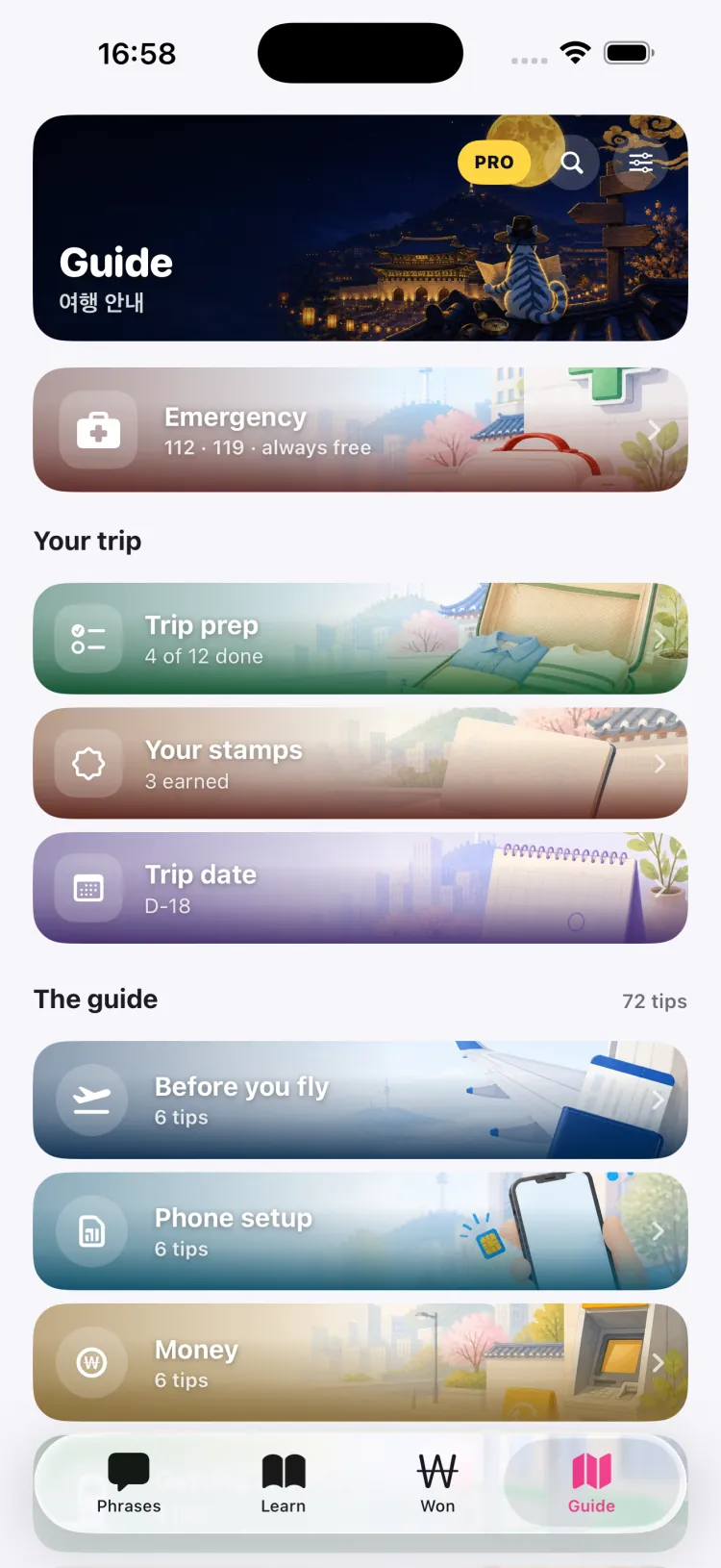
72-Tip Korea Guide
Twelve sections covering what nobody tells you before you fly: SIMs and the apps that actually work there, money, transport, etiquette, nightlife, K-beauty, day trips and emergencies.
340 Phrases, 13 Categories
Organised around the real moments of a trip to Korea
Every Phrase, Four Ways In
Read it, sound it out, hear it, or just hand the phone over — whichever gets you through the moment.
- ✓ Hangul — the Korean as it is actually written
- ✓ Revised Romanization — the official system, the one on the road signs
- ✓ Easy reading — a phonetic version written for Spanish speakers
- ✓ Clear Korean audio, plus a note on when the phrase fits and when it doesn't
- ✓ “Show it” mode — the phrase, big, for the person in front of you
Hangul in 30 Minutes
Most apps teach you the letters. Dalmaji teaches you to read — signs, menus and shopfronts — in an evening, and then tests it on real ones.
40 letters
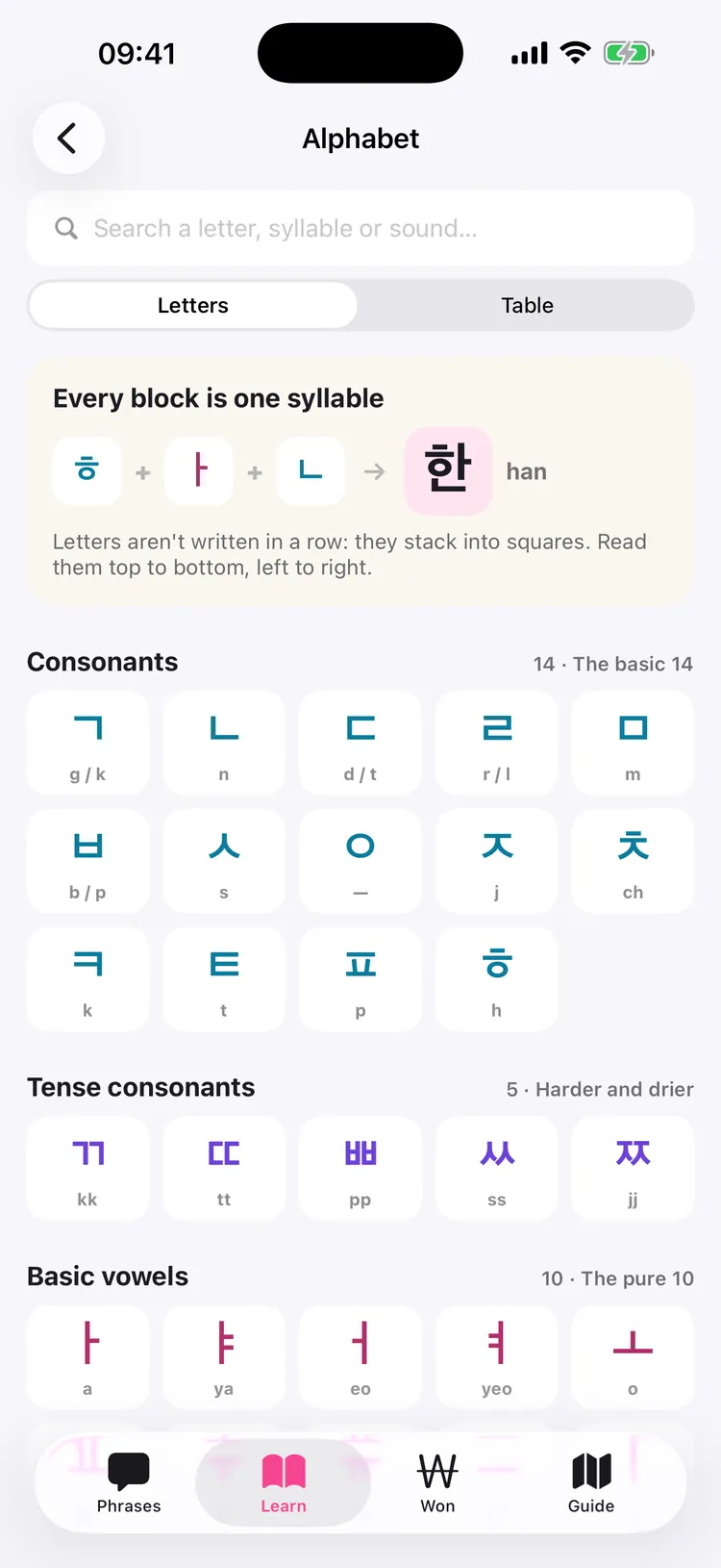
The complete alphabet, one letter at a time, with audio and the shape of each one explained.
6-lesson crash course
Reading Korean in about 30 minutes — for the night before the flight. Every lesson ends on real words you can already read.
Syllable table (반절표)
Letters stack into blocks; tap any block to see and hear it.
“Read the street”
An exam built from 12 real Korean signs that earns you a stamp when you pass: the actual test of whether it worked.
Konglish
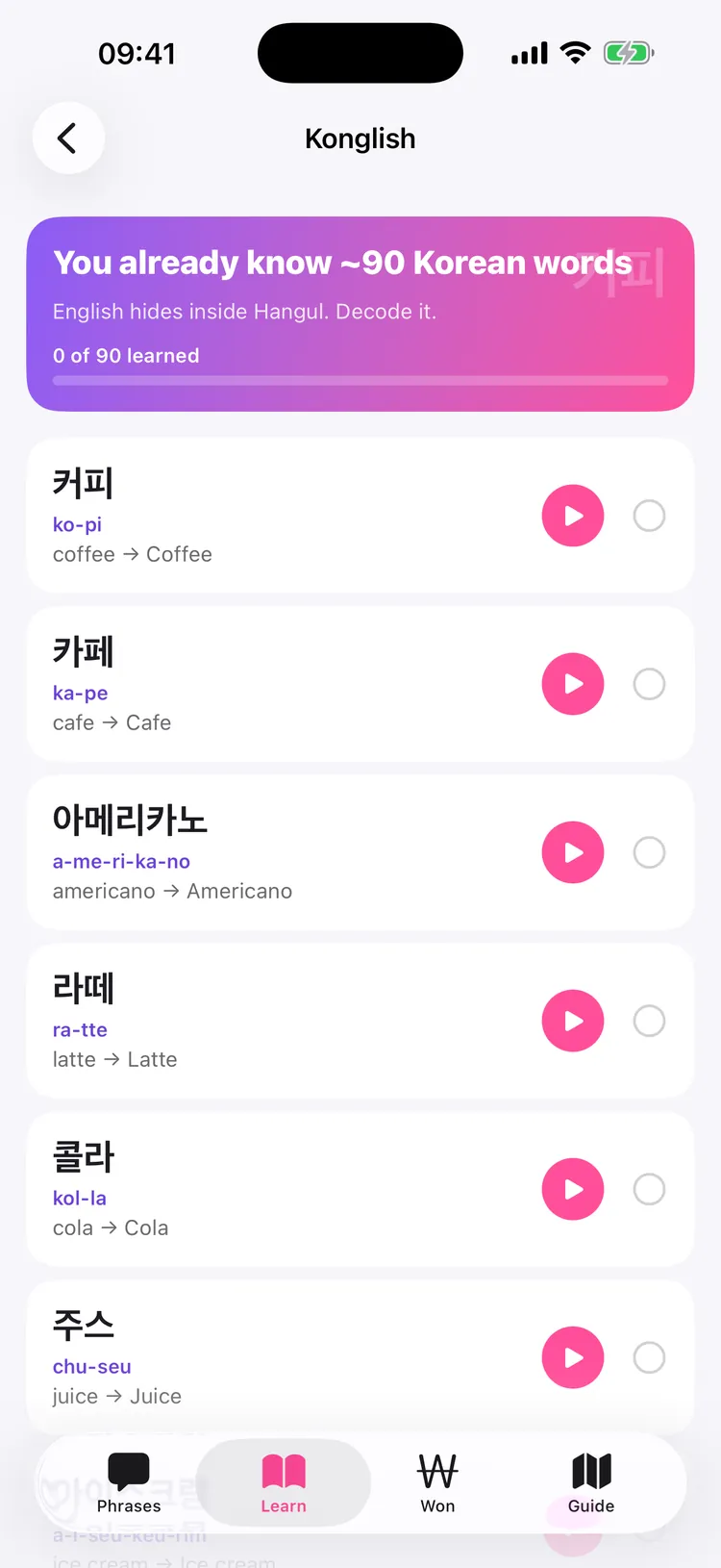
90 English loanwords you can read the moment you know the letters.
Free, all of it
The alphabet, the crash course and the exam never sit behind the paywall.
Order Without Guessing
The Menu Decoder covers 60 dishes with a plain description, a spice level and pork, seafood and veggie flags — grouped by the place you are standing in, from the barbecue table to the café counter. A first set in every scene is free; the rest come with Pro, and some arrive a couple at a time as a daily-stamp gift.





Know What Things Cost
A won converter that behaves like a travel tool rather than a calculator.
- ✓ 23 currencies, with rates refreshed whenever you are online
- ✓ The last rates are kept on the device, so it still works with no signal
- ✓ One-tap quick amounts for the sums you'll be paying
72 Korea Travel Tips
Twelve sections, a 12-point trip checklist, your trip date, and a collection of stamps (도장) to fill along the way
The Essentials Are Always Free
And Pro is one payment, once — never a subscription
Free
- ✓ Every essential and emergency phrase, in full
- ✓ A sample of every other phrase category
- ✓ All of Hangul in 30 minutes: the 40 letters, the crash course and the exam
- ✓ The 90 Konglish loanwords
- ✓ A first set of dishes in every Menu Decoder scene
- ✓ The first sections of the travel guide, and the stamp collection
- ✓ Daily stamps that give you Pro content to keep, free, up to a ceiling
- ✓ The won converter, unlimited
- ✓ “Show it” mode, for the person in front of you
- ✓ Fully offline. No account, no ads, no tracking
Dalmaji Pro
- ✨ Every one of the 340 phrases, across all 13 categories
- ✨ All 60 Menu Decoder dishes, not just the free ones
- ✨ All 72 travel tips, across the 12 guide sections
- ✨ One payment, once — never a subscription
- ✨ Free updates for life
Pro is an in-app purchase: install Dalmaji free, then unlock it from inside the app. The welcome price runs for 48 hours from the first time you open the Pro screen; after that it is $9.99. Your local price is set by the App Store or Google Play.
Perfect For
Why Dalmaji?
Built for one trip to Korea, not for an endless study streak
vs a translator app
💡 Keep both: a translator for the unexpected, Dalmaji for everything you can see coming.
vs a language-learning app
Screenshots
Frequently Asked Questions
What is Dalmaji?
Dalmaji (달맞이, “going out to see the moon”) is a Korean travel phrasebook and Hangul reading app for iPhone and Android, made by Quantum Quacks. It includes 340 travel phrases in 13 categories with Hangul, official Revised Romanization and clear Korean audio; Hangul in 30 minutes — the 40-letter alphabet, a 6-lesson crash course and a “Read the street” exam — so you can read signs and menus yourself; a Menu Decoder with 60 dishes; 90 Konglish words you already know; a won converter; and a 72-tip Korea travel guide. It works offline and ships in 12 languages.
Does Dalmaji work offline?
Yes. Every phrase, audio file, lesson, dish, tip and stamp is bundled inside the app, so all of it works in airplane mode. The only feature that touches the internet is the won converter, which refreshes exchange rates when you have a connection and keeps the last ones it downloaded for use offline.
Is Dalmaji available yet?
Yes, on both platforms. Dalmaji has been on the App Store for iPhone (iOS 17 or later) since 15 September 2026, and on Google Play for Android (7.0 or later) since 12 September 2026. It is free to download on both stores, with an optional one-time Dalmaji Pro unlock.
Is Dalmaji free?
Dalmaji is free to download, and the free tier is generous: the essentials and every emergency phrase in full — you will never hit a paywall at the moment you actually need help — a sample of every other phrase category, the whole of Hangul in 30 minutes (alphabet, crash course and exam), the 90 Konglish loanwords, a first set of dishes in every Menu Decoder scene, the first sections of the travel guide with all the emergency information, the stamp collection and the won converter. Daily stamps also hand you pieces of Pro content to keep, for free, up to a ceiling — a part of Pro, never all of it. Dalmaji Pro is an optional one-time unlock, never a subscription: it adds the remaining phrases, dishes and tips for $9.99, with a welcome offer of $4.99 during the first 48 hours after you first open the Pro screen. Your local price is set by the App Store or Google Play.
Do I need to know any Korean to use Dalmaji?
No. Every phrase shows the Hangul, the official Revised Romanization and an extra phonetic “easy reading” written for Spanish speakers, plus clear Korean audio you can replay as often as you like. And if you would rather not speak at all, “Show it” mode puts the phrase on screen, large, so the other person can simply read it.
How does Dalmaji teach you to read Hangul?
It teaches you to read, not to memorise a chart. You get the complete 40-letter alphabet, one letter at a time with audio and its shape explained; the syllable table (반절표), where you can tap any block to see and hear it; a 6-lesson crash course that gets you reading in about 30 minutes — each lesson ending on real words you can already read; and a “Read the street” exam built from 12 real Korean signs, which earns you a stamp when you pass. All of it is free.
Is the Korean polite enough to use with strangers?
Yes. All 340 phrases are written in polite -요 / -니다 forms — the ones you actually want with shopkeepers, taxi drivers and hotel staff — never casual speech, and the phrases that need it carry a short note on politeness and etiquette.
Which devices and languages does Dalmaji support?
Dalmaji runs on iPhone with iOS 17.0 or later, and on Android phones with Android 7.0 or later. The interface and all of the content — phrases, lessons, dishes, tips — are available in 12 languages: English, Spanish, Simplified and Traditional Chinese, Japanese, Vietnamese, Thai, Indonesian, Malay, Russian, French and German. The app follows your phone's language.
Who makes Dalmaji?
Dalmaji is made by Quantum Quacks, an indie studio founded by Luis Sebastian Huerta. It is the third app in the same family: Kotomaji covers Japan and Handarin covers China.

달맞이 — go out and see the moon
Dalmaji is out now on iPhone and Android. Free to download, works offline, and ready before your flight lands in Seoul.


Never Miss a Launch
New games, new apps, launch alerts, and early access — no spam, just the good stuff.